

I was coaching a CEO this week who is sitting at a pivotal moment in her business.
This year’s sales performance will be a major determinant of the company’s future. The stakes are real. The pressure is on. And the person she has in the sales leadership seat is, on paper, outstanding.
Deep industry knowledge.
Highly capable in complex financial negotiations.
Exactly who you want in the room when a deal is at the finish line.
And yet…
He drags his feet at the idea of meeting with the sales team.
Not because he can’t.
Because he doesn’t want to.
As the CEO talked, I realized that the way this sales leader was approaching leadership felt eerily familiar.
It reminded me of how many of us are treating our New Year commitment to a 5 a.m. workout this week.
You know it matters.
You know it’s good for you.
But when the alarm goes off…
snooze… snooze… sigh…
“Maybe tomorrow.”
That’s what leadership had become for this leader. Something important, necessary, and consistently postponed.
This Isn’t a One-Off. The Data Confirms It.
What I was witnessing in that coaching session isn’t rare. It’s systemic. And according to Gallup, it’s still happening.
Just last week in a Gallup poll published on January 8, their collected data shows the pattern is painfully clear:
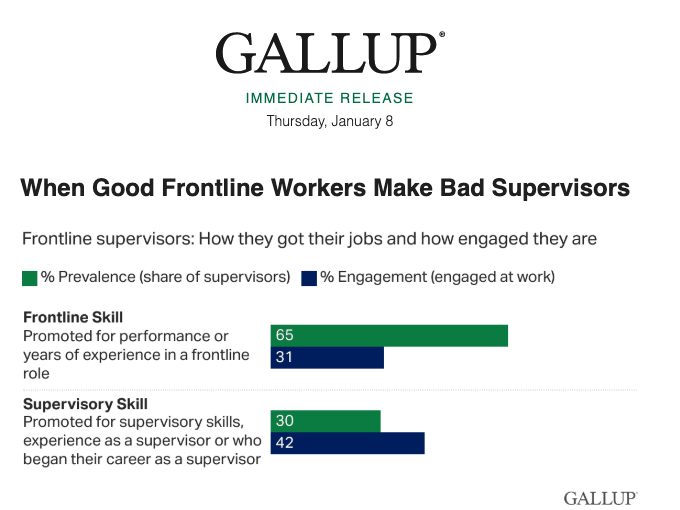
- 65% of frontline supervisors were promoted for performance or years of experience in a frontline role. Only 31% of them are engaged at work.
- 30% were promoted for supervisory skill or leadership capability. 42% are engaged.
Same organizations.
Same economic climate.
Same pressures.
Very different outcomes.
We are more likely to promote people for what they know, not for how they lead.
The Most Important Seat in the Room
Here’s the uncomfortable question I believe leaders need to ask, especially right now:
Who do you actually want in the seat?
- Someone who:
- Proactively leads the team
- Talks to them regularly
- Holds them accountable
- Helps them prioritize
- Builds stronger skills so more people can win
- Knows why the team succeeded or failed because they were there every step of the way
Or
- Someone who:
- Sits in their office
- Avoids the messy, human, repetitive work
- Waits for the final negotiation, the part they enjoy and feel competent doing
- When the team misses their numbers, goes into “Columbo mode” trying to solve the mystery
Let me be clear.
Technical expertise matters.
Negotiation skill matters.
Industry depth matters.
But leadership is not a solo sport.
If the team isn’t being led, coached, challenged, and sharpened, no amount of brilliance at the end of the funnel will save the year.
Where We Go Wrong
The problem isn’t that we promote capable people.
The problem is that we confuse individual capability with leadership readiness.
Leadership is not about:
- Knowing the most
- Being the smartest person in the room
- Doing the work yourself
Leadership is about:
- Showing up early
- Engaging before there’s a problem
- Having the conversations you don’t feel like having
- Turning potential into performance through people
And when leadership feels optional, like a workout you’ll “get to tomorrow,” the team and the organization pay the price.
A Thought to Sit With This Week
If the role requires leadership, the willingness to lead must outweigh technical brilliance.
Otherwise, we keep placing the wrong people in the most important seats and then wonder why momentum stalls, engagement drops, and results lag.
Sometimes leadership is the 5 a.m. workout.
You don’t wait until you feel like it.
You don’t outsource it.
You don’t postpone it indefinitely.
You do it because the stakes are too high not to.